Invented authority
A citation that does not exist in any supplied docket, volume, or reporter. Aletheia resolves citations against supplied sources and marks unresolved authorities without making false claims of non-existence.
Aletheia is the quotation and citation verifier for litigation drafts. It checks every quotation in a legal draft against your supplied authorities, word for word, and returns a complete Verification Packet: the draft beside annotated sources, an initialling table for counsel, and a tracked-changes Word document (.docx).
The verification packet
Checking quotations shouldn't require twenty open tabs, hunt-and-peck PDF searches, or wondering if a language model smoothed over an altered word.
Aletheia returns a unified artifact: your draft with exact inline markers, the cited authority with the matching passage highlighted, and a tracked-changes Word document showing every discrepancy, punctuation shift, and dropped negative.
Counsel’s review copy
The finding. The source. The limits.
Palsgraf v Long Is. R.R. Co.
248 NY 339, 344 [1928]“The risk reasonably to be perceived defines the duty to be obeyed”
Matched in source · p. 344
Quotation differs
Nearest source text attachedSource unresolved
No accusation of fabricationThe problem in practice
Generative AI and rushed drafting have made quotation checking both more urgent and significantly harder. LLMs frequently produce plausible-sounding authorities or subtly alter quoted language to favor an argument.
Ordinary quote checkers fail on the subtleties that matter most: they skip short quotes as “too short to verify,” ignore punctuation shifts that fuse separate sentences, and miss ellipses that quietly drop conditional clauses or negations.
A citation that does not exist in any supplied docket, volume, or reporter. Aletheia resolves citations against supplied sources and marks unresolved authorities without making false claims of non-existence.
Dropping a single negative particle or prefix (such as turning "unlawful" into "lawful") completely reverses a legal rule while leaving ninety percent of the words identical. Aletheia's negation guard catches it.
Replacing a period with a semicolon to fuse two different holdings into one synthetic sentence, or stitching text from distant pages under a single set of quotation marks.
Capabilities / Synthetic feature highlights
Every example below is drawn from our synthetic obstacle suite. No client text appears anywhere in our test cases or evaluation corpora.
Every quotation presented as a direct quote—even three words—is decided. Many checkers skip short quotes as 'too short to verify'; Aletheia decides them. Dropping 'un' in 'lawful and void' reverses the meaning and is accused.
Brief: “lawful and void” vs. Source: “unlawful and void” An ellipsis that swallows 'not', drops an operative condition ('may commence … and the court shall dismiss' over 'may commence … when the tenant remains in default'), or drops the actor so the predicate reattaches to a different subject is accused.
Brief: “may commence … and the court shall dismiss” Turning a period into a semicolon, comma, or dash to fuse two separate source sentences into one—even when every single word is verbatim—is accused. This includes sentences ending in abbreviations ('Corp.') and short quotations.
Brief: “motion is denied; plaintiff established a prima facie case” Passages from different parts of an opinion presented as one continuous quotation are accused, including multi-mark presentations with embedded quotes and star-page markers changed inside the quotation (*12 → *13).
Two distinct paragraphs stitched under one set of quotation marks A bracket the quoter wrote certifies because the reader sees it, and the report explicitly names the source words it replaced ('withheld' → '[returned]'). An empty bracket may never delete an entire word (B11).
Brief: “[returned] all statutory deposits” vs. Source: “withheld all statutory deposits” A short match that omits an adjacent 'not' is never cleared. Deterministic boundaries prevent partial-string clearances from inverting legal commands.
Brief: “shall enforce” vs. Source: “shall not enforce” Letterform confusions in a scanned source ('posijudgment', 'w1tness', 'c0urt') make the engine withhold ('source text unreliable') rather than falsely accuse counsel's brief. Real changed numbers, years, and pages still accuse.
Source scan damage in evidence window causes deliberate refusal to grade A quotation verbatim in a different supplied source is flagged as misattributed, not fabricated. A quotation in no supplied source is identified as a fabrication and accused. Short-form re-quotes inherit the full cite's verdict.
Verbatim quote matched in Exhibit D instead of the cited Exhibit B A party's contention that the court expressly rejected, even if quoted verbatim from the opinion, is not certified as support for a legal proposition.
Party argument quoted verbatim from discussion of rejected claims Page numbers, NYSCEF document stamps, county clerk headers, and '16 of 31' footers inside a quotation do not cause false accusations. Two correct quotations separated by an intervening citation are verified independently.
Quotation spanning NYSCEF footer stamps cleanly verified without deletion Evidence before reassurance
We do not rely on probabilistic confidence scores or marketing claims. Aletheia is built on deterministic algorithms verified through rigorous, reproducible obstacle suites and independent adversary attacks.
All figures below are exact counts from our verified CI obstacle suite and diff audit logs.
Graded across two independent paths (align and batch) for every change.
Adversarial corpus with exact-count pins; caught a 463-case attribution interaction.
Stack fix turned 87 silently cleared alterations into accusations (+38 align, +49 batch).
0 new silent passes, 0 new false accusations, 0 lost catches. Clearances won back, not traded.
Every quotation must agree across two completely independent verification architectures: the linear align engine and the parallel batch processor. Landing any change requires exact parity:
In our recent stack clearance audit across the 6,000-unit obstacle course:
The stack fix alone turned 87 altered quotations that were silently cleared into accusations (+38 align, +49 batch) and recovered 13 clearances with 0 new false accusations and 0 lost catches.
Align diff: Changed 40 · gained accuse 38 · 0 lost catches · 0 false accusations
Batch diff: Changed 61 · gained accuse 49 · gained clean 2 · 0 lost catches
Adversarial attack: A 4,000-case seeded fuzz corpus with exact-count pins uncovered subtle interactions (including a 463-case attribution interaction) invisible to ordinary testing. An independent adversary model (GLM-5.3) attacks every package before landing, with rulings encoded as tests.
Engineers and graders work strictly from synthetic unit IDs and verdict classes. No client text ever leaves the machine or enters the evaluation pipeline.
Sample Verification Packets
Two complete packets produced by the current verifier from synthetic demonstration material. No client or real matter content appears in either.
The sources, annotated
Human review is still required. Aletheia makes it quick.
Each packet closes with the source itself, line by line. Passages that need correction are underlined in red, verified passages in green, and every mark names the finding it supports. Counsel checks the highlighted words against the draft instead of hunting through the record.
See the annotated source in the packet →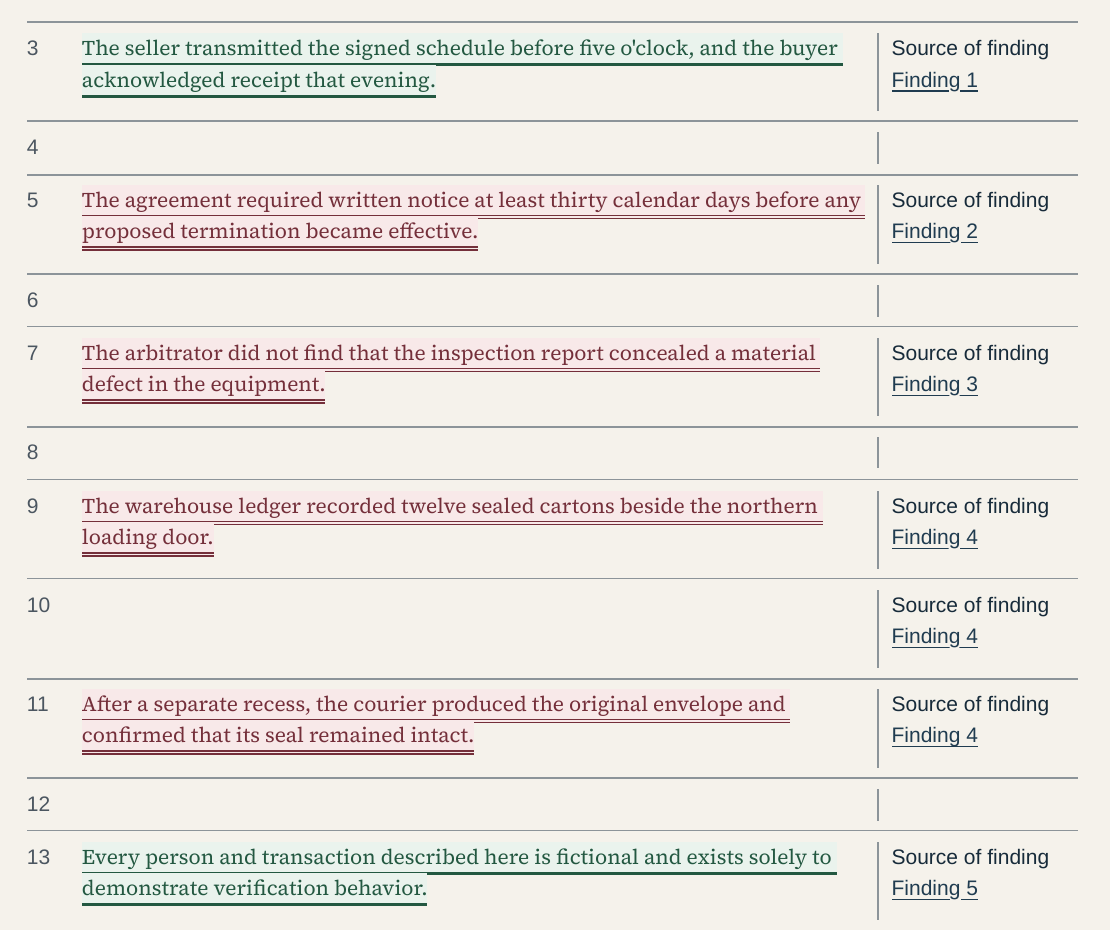
Underlying verification logic
Walk through how Aletheia separates citation resolution, extraction integrity, and final packet compilation.
Act I / Citation gate
The lookup returns no source. There is nothing reliable to set beside counsel’s words.
Illustrative lookup scenario. No real case is being classified here.
The packet preserves the search trail. It does not turn a missing source into a claim that the case was invented.
Reserved for a positive finding of non-existence. A failed search cannot cross that gate.
Act II / Record gate
…pro t by his own fra ud,
or to take adv nt–
age of his own wrong…
Damaged extraction example retained from the original demo.
The source audit runs before a model reads the text. The packet preserves the damaged span and explains why the check stopped.
No quiet repair. No verdict against words the source cannot reliably supply.
Act III / Review packet
“The risk reasonably to be perceived defines the duty to be obeyed”
Palsgraf v Long Is. R.R. Co., 248 NY 339, 344 [1928] · illustrative finding from the existing packet.
The same marker connects the draft, the cite-check table and the source text. A person reviews the evidence and signs last.
corrected A changed quotation returns with the nearest known-good text and attribution.
Explore the packetDemonstration only. This page does not run a check or accept a document.
Automate across your firm
Integrate quotation checking into your firm's document pipeline, DMS upload scripts, or pre-filing workflow. Keys issued on request. Firm keys in X-Aletheia-Key. RAM-backed temporary processing.
Read API Documentation ↗/v1/jobs Multipart: draft + sources /v1/jobs/{id} Job status & findings summary /v1/jobs/{id}/packet Download one-shot ZIP packet /v1/jobs/{id} Cancel job or discard packet Custody and privacy
Legal drafts and exhibits contain your clients' most confidential matters. Documents are processed in RAM-backed temporary storage and deleted when the job finishes. The service refuses to start if that storage is not RAM-backed.
Finished ZIP packets are held in process memory until their first download or expiry (10 minutes by default). Restarting the service loses outstanding packets.
Explore the Olympus trust and custody framework →Request access
Start with the work you want to check.
Olympus is a hosted service for New York solo practitioners and small litigation firms. This request starts an early-access conversation; it does not create an account or promise an availability date.
This form sends your contact details to Formspree. Please do not include client documents, privileged information or matter details.